Why in the world would you ever do a molecular orbital calculation? There are many reasons, but one of the most common is to understand the geometry of a molecule. The calculation can answer the following questions: What are the bond lengths? What are the bond angles? What are the bond strengths?
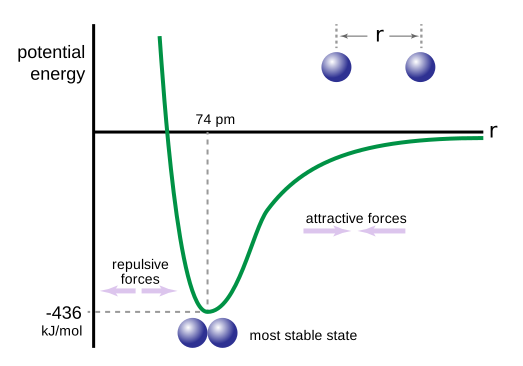
The MO calculation is a quantum mechanical calculation similar to those discussed for atomic systems. The calculation yields a set of orbitals (wavefunctions) and energies for the molecule. The electrons in the system (the molecule) can then be put into these orbitals starting from the lowest energy orbitals moving up to the highest. The wavefunctions (and their energies) for the electrons are calculated for a specific fixed position of the atomic nuclei (this is called the Born-Openheimer approximation). In this way the energy for the molecule can be calculated for a given geometry and compared to the energy of a different geometry. This is the key idea. The To find the lowest energy geometry, the energy for the molecule is calculated for all possible positions of the atoms. This meas that calculation is essentially repeated over and over and over again until the position of minimum energy is found. This lowest energy configuration is considered the ground state of the molecule. From this geometry we can get the lengths, angles, and strengths of all the bonds in the molecule. This is very hard to visualize for a large molecule as there are many degrees of freedom. However, we can easily imagine this for a diatomic system such as H2. For they hydrogen molecule there is only one thing we can change, the distance between the two nuclei. Therefore, one can perform an MO orbital calculation for different distances between the two nuclei and plot the ground state energy as of this distance. Such a plot is shown below.
You have seen this plot before when we introduced the idea of covalent bonding. Only now we can actually calculate quantitatively the energy of the molecule as a function of the distance between the two nuclei. Thus this calculation for this diatomic molecule would yield the information that the minimum energy is at a separation of 74 pm. We would say the bondlength of this molecule is 74 pm. Moreover, the difference in energy between the molecule at this distance (-436) and the atoms at infinite separation (0) is 436 kJ mol-1. We would say the bond energy for this diatomic bond is 436 kJ mol-1
This diagram is essentially a comparison between the energy of the atoms and the energy of the molecule. In MO theory we are often comparing the energy of the atomic orbitals (AO) to the energy of the molecular orbitals (MO). While this comparison could be done at any distance, we are alway making this comparison between the atom (at infinite distance) and the molecule at it lowest energy position (the bond length distance). When the MO energy is lower than the AO energy it is important to realize that this comparison is at a particular distance (the minimum energy distance).